

Earthquake Safety for Furniture: What to Consider When Choosing Storage Cabinets
Recently, earthquakes seem to be occurring more frequently.
During the colder months, people tend to spend more time at home, which can make tremors feel closer and more noticeable.
In this article, we will take a calm, practical look at some basic considerations for earthquake safety in furniture.
The first priority in earthquake safety for furniture
When it comes to preventing furniture from tipping over, the most effective measure is anchoring the furniture to the wall using L-shaped brackets or similar hardware.
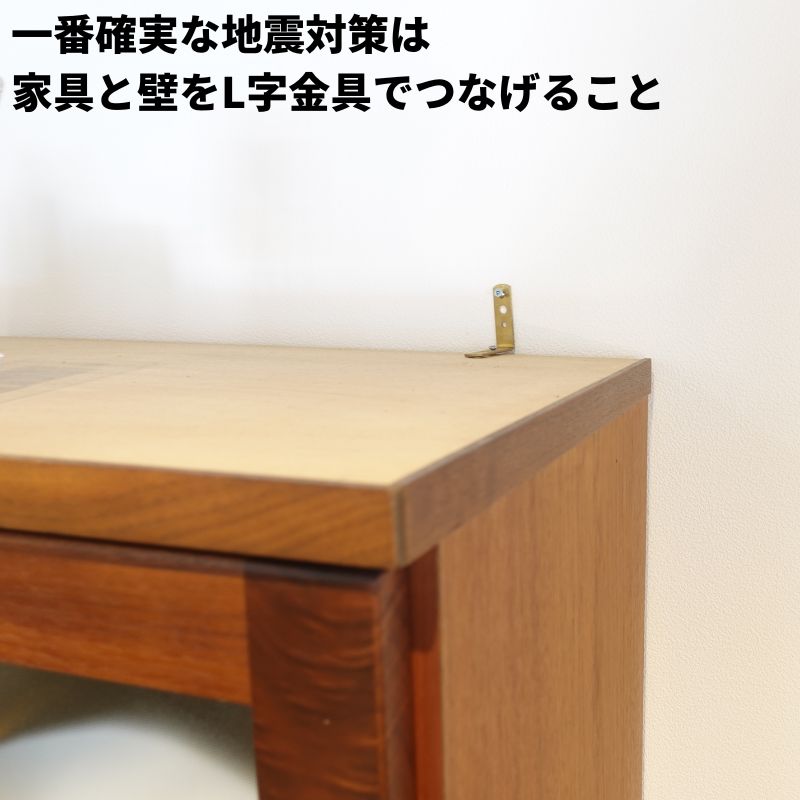
This is not a special or advanced technique.
In fact, it is a basic precaution recommended in the instruction manuals of many furniture products.
Before considering furniture type or structure, how the furniture is installed is the most important factor.
Differences depending on furniture structure
Tall furniture such as cupboards
Cupboards are typically tall and can be shaken back and forth during an earthquake.
They also store fragile items such as dishes and glassware.
If these items break, shards can scatter widely, making cleanup difficult and potentially hazardous.
For this reason, when choosing a cupboard, it is worth considering not only resistance to tipping, but also:
- Glass treated with shatter-resistant film
- Doors designed not to open unexpectedly during shaking
Cupboards that incorporate multiple safety measures like these offer greater peace of mind.
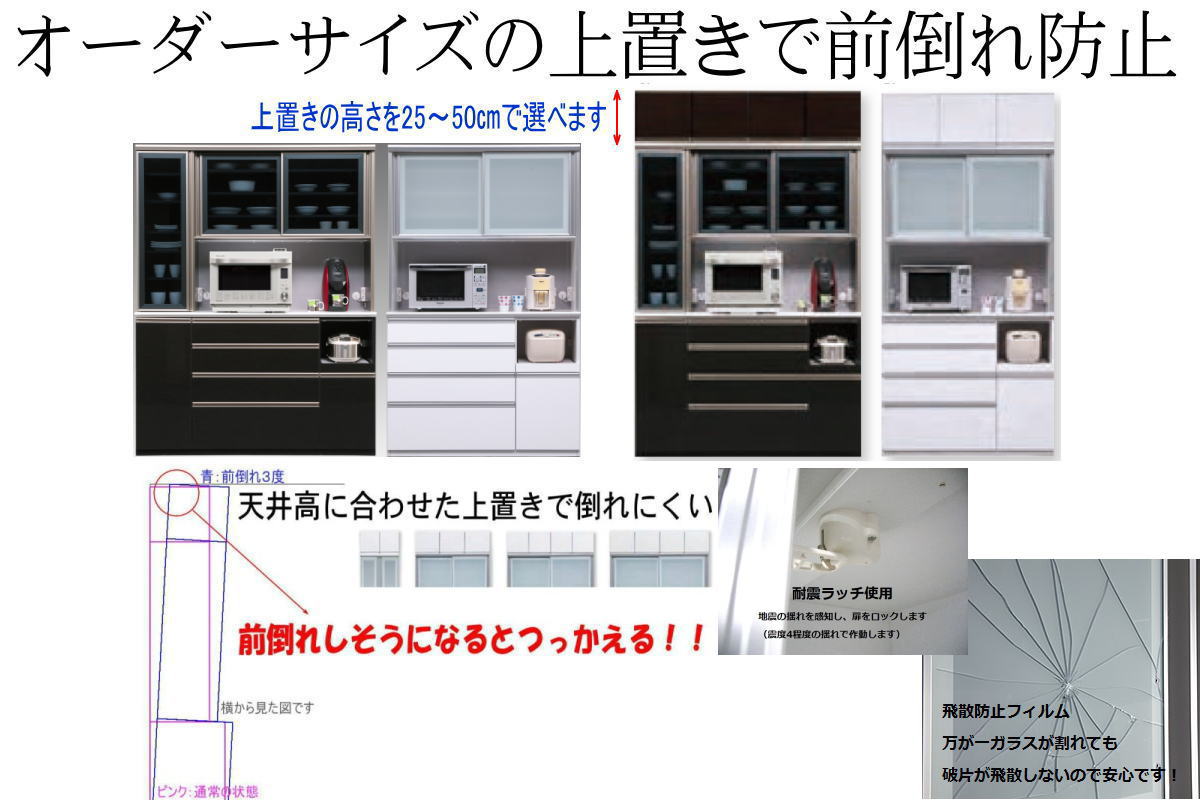
Earthquake-resistant cupboards
Chests of drawers (Tansu)
Chests of drawers involve a slightly different risk.
During an earthquake, the shaking of the furniture itself can cause drawers to slide forward.
When drawers extend outward, the center of gravity shifts forward, which increases the likelihood of the furniture tipping over.
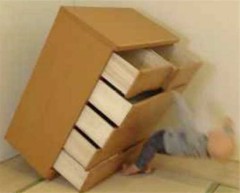
From an earthquake-safety perspective alone, drawer systems without metal rails can be structurally advantageous.
Rail-free chests of drawers (reference)
Reference
National Institute of Technology and Evaluation (NITE)
“Accidents involving children caused by tipping chests”
https://www.nite.go.jp/data/000087870.pdf
Note: This report focuses on accidents involving young children, but the structural mechanism— drawers sliding forward and shifting the center of gravity—applies broadly to furniture design.
Summary
- Anchoring furniture to the wall should be the first priority.
- Risks differ depending on furniture type and structural design.
With the recent increase in earthquakes, this may be a good opportunity to review the furniture in your home.
