

Does Furniture Really Have to Be Used Only One Way? A Japanese Approach to Choosing Furniture Beyond Categories
When we look for furniture, we often search by category without even realizing it.
If we need somewhere to work, we search for a “desk.” If we need somewhere to store books, we look for a “bookcase.” If we want a narrow piece of furniture near the entrance or along a wall, we might search for a “console table.”
Of course, that is a perfectly natural way to shop.
But after working with furniture for many years, I often find myself thinking, “This piece could actually work well for another purpose too.”
Furniture is divided into categories, but in real life, we do not necessarily have to use each piece exactly the way its category name suggests.
This way of thinking fits particularly well with Japanese homes, where people have long learned to make good use of limited space. One room may serve several purposes, and even small areas along walls or hallways may become useful storage space.
So instead of asking only, “What kind of furniture is this?”, it can be more interesting to look at the size and structure and ask, “How could I use this in my own home?”
■ We Call It a “Console Table,” but It Was Originally Designed as a Mini Desk
One of our original pieces at Okawa Kagu is a “console table” 
measuring 70 cm wide, 40 cm deep, and 70 cm high. It is made in Okawa using solid laminated natural wood such as walnut.
In fact, we originally developed it with one idea in mind:
“We want to make a small piece of furniture that can be used as a simple desk.”
There may not be enough room for a full-sized desk, but you still want somewhere to open a laptop. You may want a small workspace in the corner of a bedroom or living room.
That is why we made it only 40 cm deep.
This kind of idea also works well with Japanese homes.
Not every household in Japan has a separate home office. It is quite common to create a workspace in one corner of the living room or bedroom, or to use a dining table as a work desk when needed.
So why did we call this piece a “console table” instead of a “mini desk”?
At the time, there were not many console tables in Japan with this kind of compact size and proportion.
It can be used as a desk. But it can also hold flowers or small objects in the entrance or living room. It can work as a small display table. Add a mirror, and it can become a dressing table.
So rather than limiting it to just one purpose by calling it a “desk,” we felt that “console table” suited the piece better.
You might use it as a desk today, as a dressing table a few years from now, and later as a console in the entrance.
We would be happy if it could continue to serve a different role as your lifestyle changes.
To be honest, there are many less expensive slim desks on the market.
But our goal was not to make furniture that only works “for now.” We wanted to create a piece that could stay useful for many years, even if the way you use it changes.
That is also why we use natural wood and have it made by furniture makers in Okawa.
It may cost a little more, but we hope you will see it as a piece of furniture that can remain in your home for a long time without being limited to just one purpose.
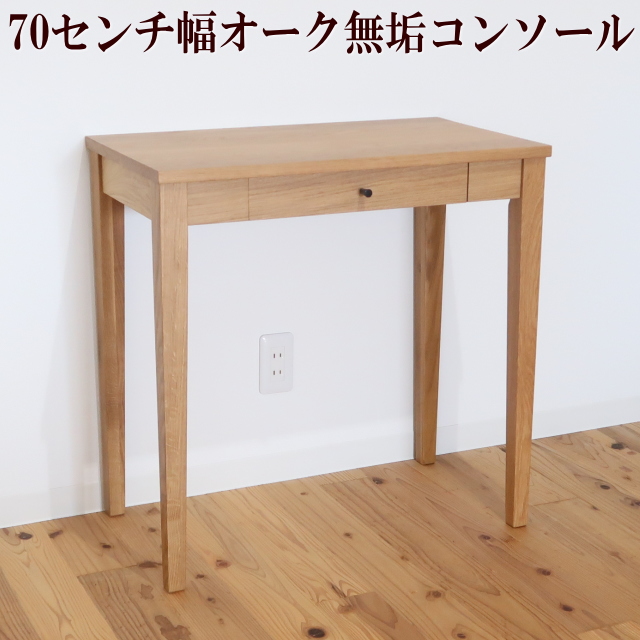
Original Console Table – W70 × D40 × H70 cm
■ Only 11 cm Deep — But It Does Not Have to Be “Just a Bookcase”
Another original piece from our shop is a slim shelving unit called “Labook.” 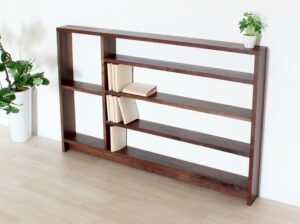
Labook Slim Bookcase – W120 × D13 × H77 cm, Custom Sizing Available
The shallowest version is only about 11 cm deep. It was originally designed as a slim bookcase for Japanese paperback books.
But again, there is no need to think of it only as a “bookcase.”
For example, consider a hallway.
In many Japanese homes, hallways and passageways are not especially wide, so placing a normal storage cabinet there can make the space feel cramped.
But with a depth of only 11 cm, the sense of pressure is greatly reduced.
You can keep a few books there, display family photos or small decorative objects, or use it near the entrance for everyday items.
It can also work well in a living room when you want just a little storage or display space without adding a large cabinet.
Labook is also made to order.
This means that the size and configuration can be customized quite freely.
For example, it is possible to make a 180 cm-high slim bookcase that is still only 11 cm deep.
A typical bookcase may require around 25–30 cm of depth, but if you mainly store paperback books, you may not need that much.
“I want more storage, but I do not want the room to feel smaller.”
In that case, instead of expanding outward, you can use height to increase storage capacity.
This way of thinking also fits well with the Japanese tradition of making the most of limited living space.
Of course, the taller a piece becomes, the more important anti-tip and earthquake safety measures are.
Because earthquakes are part of life in Japan, wall anchoring and other safety measures should be considered carefully with tall furniture.
Still, if you stop assuming that “a bookcase must look like this” and instead ask, “How could I design an 11 cm-deep piece of furniture to fit my own home?”, the possibilities become much broader.
If you no longer need it as a bookcase, it can become a display shelf. You can move it to a hallway. You can use it near the entrance.
The way we use furniture often changes between the day we buy it and ten years later.
That is why we like the idea of making furniture that can continue to be useful even when its purpose changes.
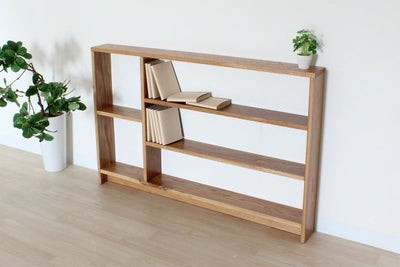
Japanese-Made Slim Shelf “Labook” – Only 11 cm Deep
■ Think About What You Want to Do, Not Just the Furniture Category
When looking for furniture, it is natural to think, “I need a desk,” “I need a bookcase,” or “I need a chest of drawers.”
But sometimes it helps to go back one step and ask, “What am I actually trying to do in this space?”
If you only use a laptop occasionally in the bedroom, perhaps you do not need a large desk. A compact console may be enough.
If you want to keep a few books and everyday items in a hallway, perhaps a conventional storage cabinet is not necessary. An 11 cm-deep shelf may work better.
And there is one more thing.
I think it is important not to think only about how you will use the furniture today.
Today it may be a work desk. A few years from now, the way you work may have changed and you may use it differently.
Today it may be a bookcase. But after your children grow up and leave home, it may become a display shelf.
In Japan, there has long been a tradition of using one space or one object in several different ways.
A Japanese-style tatami room is a good example.
During the day, it may be used as a living space. At night, futons are laid out and it becomes a bedroom. When guests visit, the same room may become a guest room.
I think furniture can be viewed in a similar way.
A desk does not have to remain a desk forever. A bookcase does not have to remain a bookcase forever.
As our lifestyles change, the role of our furniture can change too.
When you think about furniture in this way, there is more reason to choose better materials and construction, even if the initial price is a little higher.
Recently, a customer asked us:
“Can I use this chest of drawers to store dishes?”
This is exactly the same idea.
A chest of drawers is for clothes. Dishes belong in a kitchen cabinet. That is how we usually think.
But is that really a rule?
Of course, furniture has practical limits. Strength, depth, shelf capacity, and drawer load capacity all need to be considered.
Dishes are also much heavier than clothing, so the structure and load capacity must be checked carefully.
But if the structure is suitable, there is no rule saying that “a chest of drawers may only be used for clothing.”
Instead of forcing your lifestyle to fit the furniture category, choose furniture that fits the way you actually live.
And if possible, choose something you can keep using for a long time, even if its role changes.
When you approach furniture this way, a piece you had never considered before may suddenly feel exactly right for your home.
-------------------
■ A Small Disaster During Japan’s “Silver Week”
Now for something completely unrelated to furniture.
In Japan, we sometimes have a cluster of national holidays in September known as “Silver Week.”
As usual, I spent the holidays working at our showroom.
Some customers use long holiday periods to visit our physical showroom in Okawa, so I usually stay at the shop during these breaks.
This year, however, Silver Week became quite stressful.
The domain name we have used for many years, “okawakagu.com” — essentially our address on the internet — expired because we missed the renewal.
To make matters worse, we had also missed the renewal notification emails.
Our corporate website became unavailable.
Our international e-commerce site became unavailable.
And our email stopped working too.
I thought, “This is bad,” and called the domain provider for support.
But because it was during the holiday period, the first response came from AI.
In an emergency like this, the answers were too general to actually solve the problem.
So I thought, “Fine, I will log into the administration panel and fix it myself.”
Then I discovered one more problem.
The one-time login code was being sent to
an email address using the very domain that had expired.
Of course, the code never arrived.
The websites were down.
Email was down.
And I could not even log into the administration panel.
At that point, I realized there was almost nothing I could do except wait for the holiday period to end.
So yes, I spent Silver Week with a rather painful stomach(笑)
Fortunately, the domain has now been restored, and both the websites and email are working normally again.
This experience reminded me of one very practical lesson.
For important online services, it is better to register an email address that does not depend on the same service or domain you are trying to manage.
Things that work perfectly every day are often the ones that become the biggest problem when they suddenly stop working.
If you manage online services yourself, I recommend checking where your password reset emails and one-time login codes are sent.
I certainly learned this lesson firsthand(笑)
